Can You Subdivide an Acreage on Vancouver Island? What Buyers & Property Owners Need to Know
Can You Subdivide an Acreage on Vancouver Island? What Buyers & Property Owners Need to Know
One of the common questions we hear when looking at larger properties is:
“Could we subdivide this someday?”
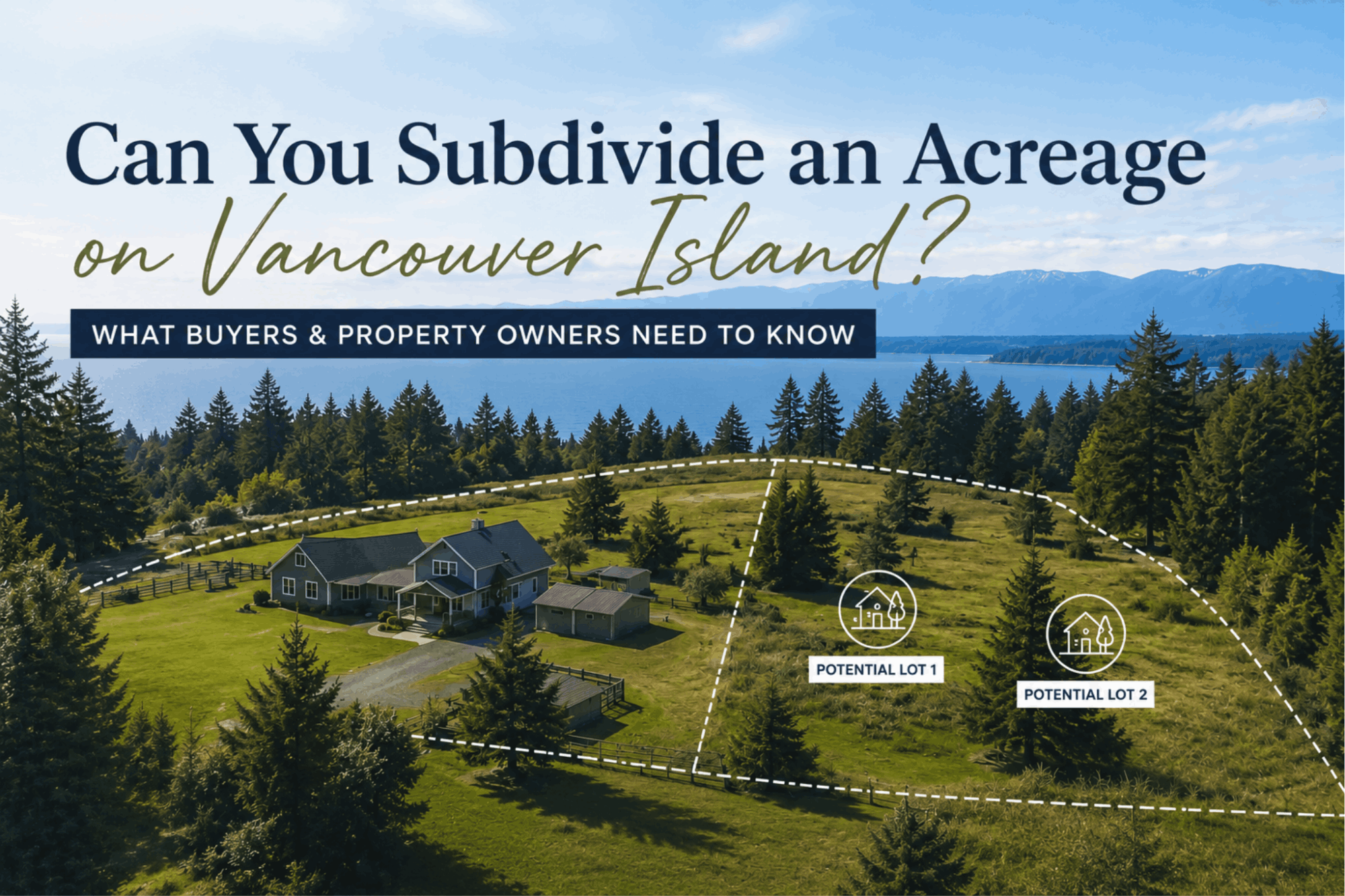
It’s an understandable question. A 5, 10, or 20-acre property can look large enough on a map that dividing it into two or more parcels seems straightforward.
Unfortunately, acreage alone doesn’t tell you whether a property can be subdivided.
Subdivision potential on Vancouver Island can depend on zoning, minimum parcel size, servicing, road access, septic suitability, water availability, environmental constraints, registered covenants, Agricultural Land Reserve (ALR) status, and the requirements of the subdivision approving authority.
A property may appear large enough to subdivide and still not qualify. Another property may have legitimate subdivision potential, but only after significant investigation, professional work and expense.
If subdivision potential is important to your purchase, it’s something worth investigating before you write an offer—or as part of your due diligence before removing subjects.
First: What Does Subdivision Actually Mean?
Subdivision is the legal process of dividing one parcel of land into two or more separate parcels, each with its own legal description and title.
Once approved and registered, those parcels can generally be owned and transferred separately.
For example, a 10-acre property might potentially be divided into two 5-acre parcels—but only if the applicable rules allow it and each proposed parcel satisfies the requirements for subdivision.
Simply owning 10 acres does not automatically give you the right to create two 5-acre lots.
The Province provides an overview of the subdivision approval process in British Columbia, including the additional process applicable to land outside municipalities.
1. Start With the Property’s Zoning
One of the first things to investigate is the property’s zoning.
Local zoning bylaws can establish minimum parcel sizes and other requirements that affect subdivision potential. These rules vary considerably across Vancouver Island.
For example, if a zone requires a minimum parcel size of 5 acres, a 10-acre property might appear to have enough land to create two parcels.
But that still doesn’t mean subdivision will be approved.
The configuration of the land, servicing requirements, road access, environmental restrictions and other regulations may make subdivision impractical or impossible.
Minimum parcel size is a starting point—not a guarantee of subdivision approval.
2. Who Actually Approves a Subdivision?
This is where rural properties can become confusing.
Within municipalities, subdivision applications are generally considered by the municipality’s Approving Officer.
For properties in regional district electoral areas—and in the Islands Trust area—subdivision approval is currently handled by a Provincial Approving Officer through B.C.’s Ministry of Transportation and Transit.
The local regional district may still have important zoning, servicing, development permit and land-use requirements that apply to the property, even when it isn’t the authority granting final subdivision approval.
That distinction matters on Vancouver Island because many farms and acreages are located outside municipal boundaries.
The Province publishes a very useful Rural Subdivision Approvals Guide that explains the rural subdivision process, approving authorities, applications, referrals and many of the issues considered during subdivision review.
3. Is the Property in the Agricultural Land Reserve?
If the property is within the Agricultural Land Reserve (ALR), there is another major layer to consider.
Subdivision of ALR land is subject to the Agricultural Land Commission Act and its regulations. The ALC's guidance makes clear that subdivision generally requires Commission approval unless the proposal falls within one of the circumstances specifically permitted under the legislation or regulations.
The purpose of the ALR is to preserve agricultural land and support farming, so subdivision proposals are not considered simply on the basis of whether the resulting parcels would satisfy local zoning.
In fact, the ALC specifically cautions that it is not obliged to approve a subdivision simply because the proposed parcels meet the minimum parcel size in a local bylaw.
This means a property could potentially satisfy a local government’s minimum parcel-size requirements and still not receive approval to subdivide through the ALC process.
Before assuming an acreage can be subdivided, buyers should therefore confirm whether any portion of the property lies within the ALR.
The ALC provides an online ALR Property and Map Finder that allows you to search by civic address or Property Identifier (PID) and view the property's ALR status.
Agricultural capability can also become an important part of an ALR subdivision application.
When reviewing a proposed subdivision, the ALC may consider the agricultural capability and suitability of the land, how the proposed lot configuration could affect existing or future farming, and whether subdivision would fragment or reduce the long-term agricultural usefulness of the property.
Depending on the property and proposal, this may involve reviewing existing agricultural capability and soil mapping, and additional technical information may be requested during the application process. In some circumstances, applicants may also engage a Professional Agrologist to assess the land's agricultural capability or provide an expert opinion in support of the application.
A detailed soil or agricultural capability assessment is not automatically required for every subdivision application, but it can become an important piece of evidence where the agricultural quality or characteristics of different portions of the property are relevant to the proposal.
The ALC provides access to agricultural capability mapping and B.C. soil information, and it has established specific criteria for professional agricultural capability assessments.
4. Could a Bare Land Strata Be an Alternative?
In some situations, it is also worth investigating whether a bare land strata could provide an alternative subdivision structure.
A bare land strata is a form of subdivision in which the strata lots themselves are parcels of land rather than portions of a building. Other portions of the development can become common property shared through the strata corporation.
What makes this particularly interesting for some acreage properties is that B.C.’s Bare Land Strata Regulations provide some flexibility where a zoning bylaw establishes a minimum parcel size.
An Approving Officer may, in certain circumstances, approve individual bare land strata lots that are smaller than the minimum parcel size specified in the zoning bylaw. However, this does not mean minimum parcel-size requirements can simply be ignored.
Among other requirements, the total area of the land in the bare land strata plan—excluding portions intended to provide access routes—divided by the number of proposed strata lots must meet the applicable minimum or average parcel-size requirement. The Approving Officer must also be satisfied that an appropriate building or structure can be constructed on each proposed strata lot in compliance with the applicable zoning or development permit.
So, depending on the property, a bare land strata may allow a different configuration of individually owned land and common property than would be possible through a conventional fee-simple subdivision.
But there is an important distinction:
A bare land strata is not a way to bypass the subdivision approval process.
Bare land strata plans still require approval by an Approving Officer and must comply with the applicable zoning, the Strata Property Act, the Bare Land Strata Regulations and other applicable requirements. The regulations themselves contain requirements relating to matters such as access, water, sewage disposal and drainage.
And if the property is within the ALR, a bare land strata does not provide a way around the Agricultural Land Commission. The ALC specifically identifies strata plans as plans that cause subdivision, meaning the ALR subdivision rules still apply.
For the right property, however, asking whether a bare land strata could be considered alongside a conventional fee-simple subdivision may be worthwhile when investigating development potential.
5. Water Can Be a Major Factor
Water availability can become particularly important when creating new rural lots.
Where community water isn’t available, subdivision requirements may require proposed parcels to demonstrate an adequate source of potable water, depending on the applicable regulations and bylaws.
For bare land strata developments specifically, B.C.'s regulations state that where connection to a community water system isn't required, the Approving Officer must be satisfied that each strata lot has an adequate proven source of potable water, or that an acceptable water distribution system will supply the strata lots.
Depending on the property and applicable requirements, investigating water could involve wells, water testing, proof of flow or other supporting information.
A property having one productive well doesn’t necessarily mean there is sufficient water—or an acceptable water source—for every parcel you hope to create.
This is one reason subdivision feasibility should be investigated carefully on rural properties.
6. Septic & Sewage Disposal Matter Too
Many rural Vancouver Island properties aren’t connected to municipal sewer systems.
That means sewage disposal can become an important part of subdivision feasibility.
Soils, slopes, groundwater conditions, setbacks, watercourses and available usable area can all affect whether an appropriate onsite sewage system can be constructed.
A 10-acre property may have plenty of land overall, for example, while only a relatively small portion is suitable for septic.
When subdivision is a serious objective, consulting an Authorized Person under B.C.’s onsite sewage framework may be an important part of the feasibility investigation. Under B.C.'s Sewerage System Regulation, an Authorized Person is a registered onsite wastewater practitioner or an appropriately qualified professional.
You can review the current B.C. Sewerage System Regulation for the provincial framework governing onsite sewage systems.
Bare land strata developments are also specifically addressed in the Bare Land Strata Regulations: where connection to a sewage collection and disposal system isn't required, the Approving Officer must be satisfied that an appropriate sewage disposal system can be constructed on each strata lot or that an acceptable common sewage system will serve them.
7. Road Access & Frontage Can Affect What’s Possible
Access can have a significant effect on subdivision design.
Depending on the property and proposed subdivision, this could involve:
- existing public-road frontage;
- construction of a new road;
- upgrades to an existing road;
- access design and safety requirements;
- rights-of-way or easements; and
- requirements imposed by the applicable Approving Officer.
B.C.'s Local Government Act allows local governments to establish subdivision servicing requirements relating to highways and other infrastructure.
A parcel that looks easy to divide on an aerial map may become considerably more complicated once legal and physical access are considered.
8. The Shape and Terrain of the Property Matter
Ten acres of relatively level, accessible land can be very different from ten acres divided by a creek, steep ravine, wetland, cliff or irregular property boundary.
Subdivision design may need to account for:
- steep slopes;
- watercourses and riparian areas;
- wetlands;
- flood hazards;
- environmentally sensitive areas;
- existing buildings;
- wells and septic systems;
- utility corridors;
- setbacks; and
- access.
The Province confirms that health, safety, environmental and land-use considerations form part of the subdivision review process for land outside municipalities, and applications can be referred to other agencies for their recommendations or approvals.
The usable configuration of the land can matter just as much as the total acreage.
9. Existing Buildings Can Complicate a Proposed Lot Line
This is something buyers don’t always think about.
Suppose a property contains a house, barn, shop, well and septic field. A proposed new property line can’t simply be drawn wherever it looks convenient.
The resulting parcels may need to continue satisfying applicable requirements involving building setbacks, access, sewage disposal, wells and other infrastructure.
Sometimes the location of existing improvements significantly limits how a property can realistically be divided.
10. Check the Title for Covenants and Other Registered Interests
Zoning isn’t the only thing that can restrict land.
A property’s title may contain:
- restrictive covenants;
- easements;
- statutory rights-of-way;
- access agreements;
- utility rights-of-way; or
- other registered charges.
Some registered instruments may specifically restrict subdivision or development.
Others may not prohibit subdivision outright but can affect where roads, buildings, septic systems or utilities can be located.
The Province's rural subdivision process also contemplates documents such as restrictive covenants, easements and rights-of-way being registered along with an approved subdivision plan.
This is why reviewing the title and relevant registered charges is an important part of evaluating subdivision potential.
11. Subdivision Can Trigger Significant Costs
Even where subdivision appears possible, the cost can be substantial.
Depending on the property, expenses could include:
- surveying;
- engineering;
- environmental assessments;
- geotechnical work;
- water investigations;
- septic assessments;
- road construction or upgrades;
- utility servicing;
- drainage works;
- application fees;
- legal fees; and
- other works required as a condition of approval.
B.C.’s Local Government Act allows local governments to establish subdivision servicing requirements involving highways, water distribution, sewage collection and disposal, drainage and other works and services.
Bare land strata isn't necessarily a cheaper way around those issues either. Its regulations contain specific provisions relating to water, sewer and storm drainage infrastructure and can require construction of servicing—or, in certain circumstances, security for the cost of completing required systems—before approval.
In other words, “subdividable” doesn’t necessarily mean “economically worthwhile to subdivide.”
Can a REALTOR® Tell You Whether a Property Can Be Subdivided?
A REALTOR® experienced with rural property can help identify potential issues, review available zoning and property information, obtain relevant documents, and help determine which authorities and professionals should be consulted.
But subdivision approval ultimately rests with the applicable approving authorities.
For that reason, we are very careful about describing a property as “subdividable” unless there is reliable documentation supporting that statement.
There’s an important difference between:
“The current zoning appears to permit a minimum parcel size that may allow subdivision.”
and:
“This property can be subdivided.”
Those statements are not interchangeable.
Who Actually Approves a Subdivision?
The approving authority depends largely on where the property is located.
If the property is within a municipality, the subdivision application is generally handled through the municipality, with final approval given by its designated Approving Officer.
For most rural properties outside municipal boundaries, subdivision applications are handled through the B.C. Ministry of Transportation and Transit, with approval given by a Provincial Approving Officer.
The regional district still plays an important role. Its zoning and other applicable bylaws continue to apply, and the Province may refer the application to the regional district, health authority and other agencies for review or additional requirements.
In other words, for many Vancouver Island acreages, you may be dealing with both the regional district and the Province: the regional district regulates land use through zoning and other bylaws, while the Ministry of Transportation and Transit handles the subdivision approval process.
What Should You Ask When Considering an Acreage for Subdivision Potential?
If future subdivision is important to you, some of the questions worth investigating include:
- What is the current zoning and minimum parcel size?
- Is any portion of the property within the ALR?
- Who will applications need to be sent to?
- Has conventional fee-simple subdivision been investigated, and could bare land strata be another structure worth considering?
- Is there adequate legal and physical access for the proposed parcels?
- What water and sewage disposal requirements apply?
- Are there creeks, wetlands, steep slopes or other environmental constraints?
- Are there covenants or registered charges affecting subdivision?
- Where are the existing house, buildings, well and septic system located?
- Could servicing or infrastructure requirements make the subdivision financially impractical?
- Has the owner previously made a subdivision application or preliminary inquiry?
If subdivision is a major reason you’re purchasing the property, it may also be worth having a B.C. land surveyor, planner, engineer, septic professional or other appropriate specialist review the property before you commit to the purchase.
The Bottom Line
A large acreage does not automatically equal subdivision potential.
On Vancouver Island, subdivision can involve several overlapping layers of regulation, particularly for rural properties and land within the Agricultural Land Reserve.
If you’re considering an acreage because you hope to subdivide it later, don’t rely solely on the lot size, listing description or a line in the zoning bylaw. Investigate the property itself, the applicable regulations, servicing requirements and title before making subdivision potential part of your financial plan.
That’s especially important when you’re buying farms and acreages for sale on Vancouver Island, where wells, septic systems, ALR status, road access and environmental features can all affect what is actually possible.
If you’re looking at a property and wondering whether subdivision may be realistic, we’re always happy to help you gather the available information and identify the right questions to ask before moving forward.
Chat soon,
Maegan Morton & Loralee Burns
West Coast Property Team – Proudly Powered by B.C. Farm & Ranch Realty Corp.
Licensed REALTORS®
778-743-2380
Categories
Recent Posts